The family around Kortrijk
The marriage in Harelbeke in 1619 and the children's baptisms in Harelbeke, Marke and Kortrijk firmly connect Joannes Dobbelaer and Joanna Verhaeghe to the Kortrijk region.
A family history from Zeelandic Flanders
From the Kortrijk region through the new polders around Stoppeldijk to the bargemen of Terneuzen and the Rotterdam branch. A story spanning twelve generations, with grandfather Abraham's Eerste Zorg at its floating heart.
Genealogy · inland shipping · Reynard country · surname history
The family story
The documented ancestral line begins with Joannes Dobbelaer, born around 1595, who married Joanna Verhaeghe in Harelbeke in 1619. Their family subsequently appears in Harelbeke, Marke, Deerlijk and Kortrijk. In the next generation, the family emerges in the recently reclaimed Stoppeldijk polder.
The family's centre of gravity then shifts through Boschkapelle and Hoek to Biervliet and Terneuzen. Land and water repeatedly shape their work: polder labour, inland shipping, locks and bridges.
The children of Joannes and Joanna appear between 1621 and 1636 in the parish registers of Harelbeke, Marke and St Martin's parish in Kortrijk. Deerlijk enters the story from 1642 in the next generation. From 1649, members of the Dobbelaer family are demonstrably present in the recently reclaimed Stoppeldijk polder. Identifying the pioneer Adrianus as their son is strongly supported by relatives acting as witnesses, recurring names, DNA indications and the migration context, but his baptismal entry has not been found. The connection is therefore plausible, rather than fully proved by an unbroken sequence of records.
Weighing the evidence
Not every connection carries the same weight of evidence. Each strand therefore has its own status.
The marriage in Harelbeke in 1619 and the children's baptisms in Harelbeke, Marke and Kortrijk firmly connect Joannes Dobbelaer and Joanna Verhaeghe to the Kortrijk region.
Nicolaes, Joanna Verhaeghe and Elisabeth reappear in sources from Zeelandic Flanders. Their disappearance from the Kortrijk registers coincides with their appearance around Stoppeldijk.
Y-DNA research linked branches in Zeelandic Flanders that had previously been considered separate. This supports a shared paternal ancestor, but does not by itself establish a birthplace.
Early forms of the surname and medieval gaming culture provide meaningful context. They do not establish that the earliest known ancestor ran a dice house or descended from a medieval bearer of the name.
From south to north
The move to the newly reclaimed polder fits into a wider history of land reclamation, employment and administrative ties between the Kortrijk region and Hulsterambacht.
Marriage of Joannes and Joanna
Harelbeke, Marke, Deerlijk and Kortrijk
Reclaimed polder near Hulst and Axel
Generations in the polder
The bargemen's line
Eerste Zorg and the generations that followed
The church chapter connection. G. Pidance, revenue collector for the Chapter of Our Lady in Kortrijk, was also present when construction of the Stoppeldijk closure dyke was put out to tender in 1644. The family source considers this a plausible historical route through which people around Kortrijk could have heard about work and settlement in the new polder. This is contextual evidence, not an individual migration record.
The direct line
The line below follows the branch through Piet Dobbelaar, son of Abraham. It shows only the direct ancestors.
Harelbeke and the Kortrijk region
Married Joanna Verhaeghe on 27 November 1619 in Harelbeke.
Harelbeke, Deerlijk, Stoppeldijk
The uncommon given name Nicolaes is an important clue in the reconstruction.
Stoppeldijk and the Hulst region
Born in Stoppeldijk and baptised in Hulst.
Boschkapelle
Lived with his family in the newly established polder community.
Boschkapelle
Labourer, married to Josina Verschueren.
Stoppeldijk, Biervliet and Hoek
Bargeman. With him, inland shipping becomes a recognisable family tradition.
Hoek, Biervliet and Terneuzen
Bargeman and father of Pieter Dobbelaar.
Biervliet, Terneuzen and Sliedrecht
Barge hand and later a skipper on the Rhine.
Terneuzen
Bargeman, married to Tannetje Jacoba de Ridder.
Wemeldinge, Biervliet and Terneuzen
Inland skipper and owner of the Eerste Zorg.
Biervliet and Rotterdam
Bridge and lock keeper at the Koninginnebrug in Rotterdam.
The Rotterdam branch
The line continues to Bram Dobbelaar. Details about living family members are kept limited.
A chapter on the water
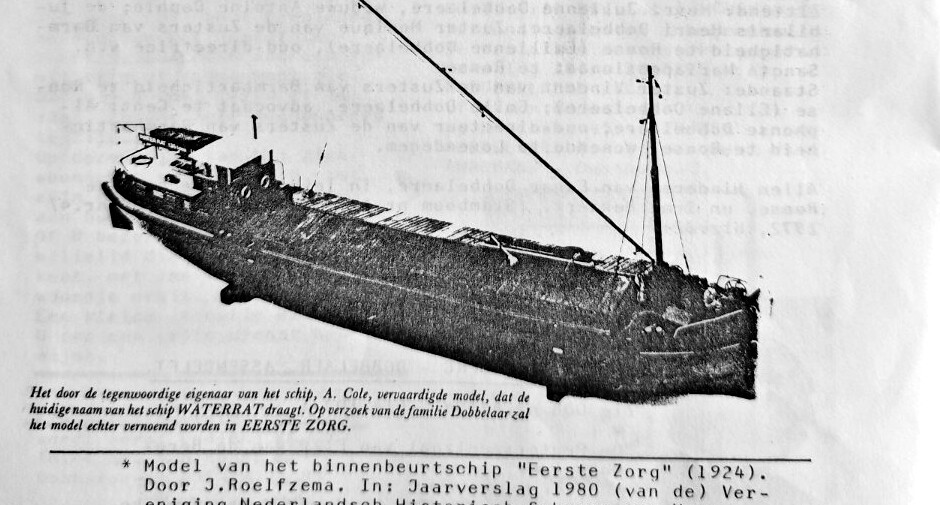
Abraham Dobbelaar was born in Wemeldinge on 17 May 1896. In 1924, the year he married Maria Dees, he had his own vessel built at the age of 27.
Abraham came from a bargeman's family and learned the trade on board as a boy. According to the family article, construction cost around 25,000 guilders. With Maria, a deckhand and later five children, he kept sailing, even when the weather and holidays offered little rest.
“Keep going” was how the family summed up his outlook on life.
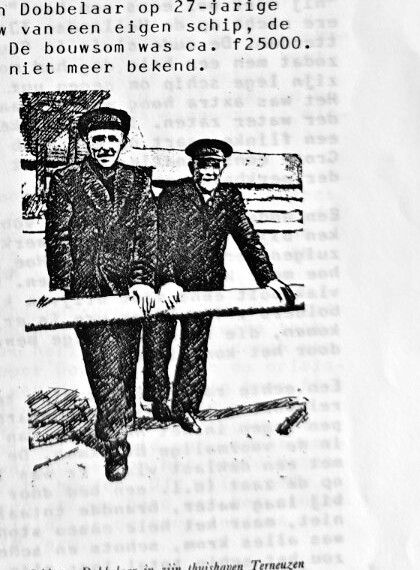
The Eerste Zorg was sold in 1962 and used as a houseboat. A later owner, A. Cole, built a detailed model. It eventually entered what was then the Netherlands Historical Maritime Museum in Amsterdam. At the family's request, the model retained the name Eerste Zorg.
View the first archival pageThe literary landscape
Van den vos Reynaerde mentions places in and around the Hulst region. Hulsterloo and Absdale are recognisable landmarks in the geography of Reynard the Fox. The author knew the area between Ghent, the Waasland and Hulsterambacht well.
For the Dobbelaar family, this is a connection through landscape and culture, rather than genealogical descent. For generations, their ancestors lived in the same polders, villages and border region that appear in and around the medieval animal epic.
In the eastern part of Flanders stands
A wood, and it is called Hulsterloo
The surname and medieval culture
The Dutch word sounds like a school, but historical sources used it with a different meaning.
A dobbelschool was a dice house or gaming house. A territorial lord or town could grant a monopoly on operating such a house and receive revenue from it.
The Dutch Surname Database explains Dobbelaar as a nickname for someone known as a skilful or avid dice player. This makes medieval gaming culture relevant to the history of the name.
Medieval Kortrijk had a right to organise dice gaming granted by the count. On 28 December 1335, Louis of Crécy granted his servant Johannot le Nain the “école du jeu de dés à Courtrai”.
A parallel archival description calls this “le escole dou jeu de deys del eschekier” and states that the right applied throughout Kortrijk's municipal jurisdiction. It was probably a right granted by the count to operate lawful gaming establishments. No specific street or inn is named.
This archival reference describes the historical context. It does not prove a direct connection to the Dobbelaer family.
Branch 59 is particularly interesting. Three differences across 37 Y-STR markers were found between branch 59 and branches 23/29/34. De Dobbel-Beker suggests that their shared male ancestor may therefore have lived as early as the beginning of the fourteenth century. The authors also warn that this date has a wide range of uncertainty. The most cautious conclusion from the DNA is that the shared ancestor probably lived before the seventeenth century.
Branch 59 also has a clear geographical connection to Kortrijk. Its earliest known man is Andreas De Dobbelaere. His son Bartholomeus, also called Meeuwel, lived in Tielt-Buiten and was listed from 1638 as a non-resident citizen of Kortrijk. A Kortrijk tax register from 1571 also records a Meeuwel De Dobbelaere who rented a house in Kortrijk and later left.
As Meeuwel was a fairly uncommon familiar name, the family researchers suspected that this Meeuwel from Kortrijk might represent an earlier generation of branch 59. This has not yet been proved.
An unknown Dobbelaere in the Kortrijk regionpossibly around 1300 to 1500
Family line leading to Andreas and Bartholomeus, or MeeuwelBranch 59
Family line leading to the ancestors of Joannes Dobbelaer, c. 1595 → Nicolaes and Adrianus → StoppeldijkBranches 23/29/34/31/33/40
In this model, Joannes, born around 1595, is not the beginning of the family. He is simply the earliest point currently reachable through written sources. The Y-DNA match suggests that a male Dobbelaere line existed in West Flanders centuries before him.
The presumed shared ancestor of branch 59 and the Zeelandic Flanders branch may have lived in roughly the same broad period as the Kortrijk dice house recorded in 1335. This makes a historical connection in time, region and surname conceivable, but does not prove that an ancestor owned, operated or worked at the dice house.
No evidence was found in the sources consulted that Joannes Dobbelaer or his known ancestors owned a dice house in Harelbeke or Kortrijk. The explanation of the surname is plausible, but is not evidence about a particular individual.
The keeper of a dice house had to oversee fair play and prevent cheating with the dice. In the present, twelfth generation, Bram Dobbelaar works on PRN noise code generators and experiments in which a quantum computer produces randomness.
This does not prove a historical continuity of occupation, but it does offer a striking family parallel: then as now, the question is how to know whether chance is truly fair.
Sources and accountability
This site distinguishes archival records, genealogical reconstructions and cultural and historical context. New records or DNA results may refine parts of the reconstruction.